What Is Evolutionary Baggage?
You might think that the human body, if well cared for, is perfect. It’s not. Our bodies are the product of millions of years of evolution. Yet evolution doesn’t strive for perfection. Rather it favors traits well adapted in a particular environment and increased reproductive success. How does it happen? Through variation and natural selection. Variation arises through mutations and other genetic changes that results in altered trait upon which natural selection acts changing the frequency of that trait in a population. But we need to address something important about variation. It has limits. Every crazy option isn’t available. It’s like, you cannot write a musical piece which cannot be played on an instrument. Living systems are like instruments. Every time a variation emerged it didn’t mean that evolution started with a blank slate or built an anatomical structure from scratch. It appeared as a change in existing genetic code consequently changing existing structure or function. Over millions of years, these small, naturally selected, heritable changes can transform an existing structure into something completely new. But remember it wasn’t built from the scratch so you might see some of its structural or functional resemblance with its ancestral structure. There are many examples of such structures can be found throughout living world. They are living historical archives. Historical marks left in our bodies even inside our genome. This is our evolutionary baggage.
The Human Body’s Evolutionary Scars
The Human Spine and the Cost of Walking Upright
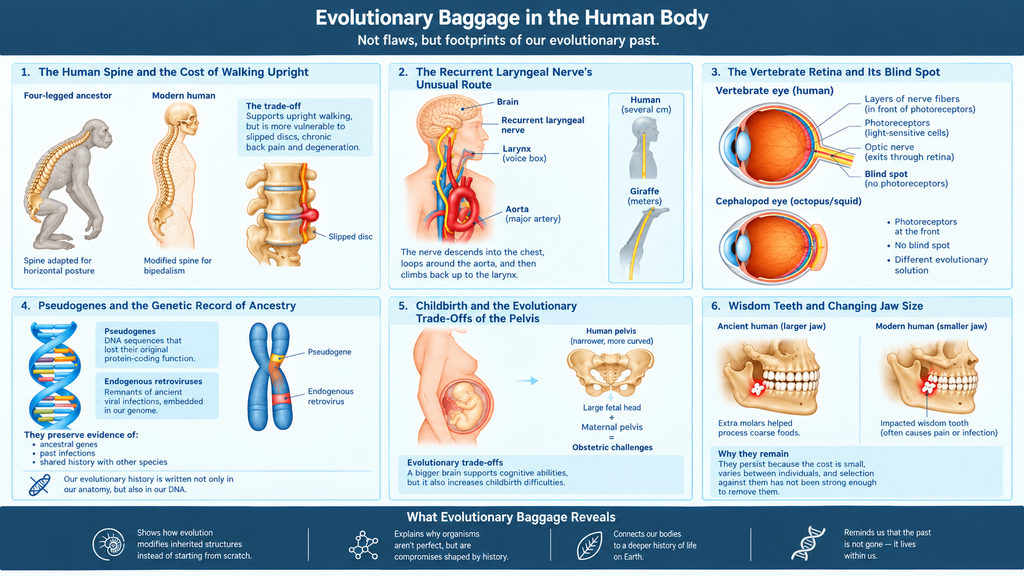
The human body is filled with reminders of its evolutionary past. Consider the spine. Our distant ancestors were four-legged mammals, and their spinal architecture was suited to a body carried horizontally. When our lineage evolved upright walking, evolution did not begin with a blank slate. It modified an inherited structure to meet new demands. The result is a spine remarkably capable of supporting bipedalism, yet vulnerable to slipped discs, chronic back pain, and degeneration. These problems are not simply design failures. They reflect the compromises involved in modifying an existing structure for a new way of life.
The Recurrent Laryngeal Nerve’s Unusual Route
Another striking example is the recurrent laryngeal nerve. This nerve connects the brain to the larynx, or voice box, but takes an unexpectedly indirect route. Instead of traveling directly to the larynx, it descends into the chest, loops around a major artery, and then climbs back up toward the neck. In humans, this detour spans several centimeters; in giraffes, it extends for meters. The explanation lies in our distant vertebrate ancestry. In ancient fish, the corresponding nerve passed around structures near the gills. As vertebrate anatomy changed and necks lengthened, the nerve’s route changed with it. Evolution modified an inherited pathway rather than producing an entirely new one. What remains is a functional nerve whose route preserves a remarkable trace of evolutionary history.
The Vertebrate Retina and Its Blind Spot
The vertebrate eye reveals a similar story. In humans, the retina is organized in a way that places layers of nerve fibers and other cells in front of the light-sensitive photoreceptors. The optic nerve also exits through the retina, creating a blind spot where photoreceptors are absent. Our brains compensate so effectively that we rarely notice it. Cephalopods, including octopuses and squids, have independently evolved eyes with a different retinal arrangement and no equivalent blind spot caused by the optic nerve’s passage through the retina. The contrast illustrates how different evolutionary histories can produce different anatomical solutions to similar problems. The vertebrate eye works remarkably well, but its organization bears the marks of the pathway through which it evolved.
Pseudogenes and the Genetic Record of Ancestry
Evolutionary baggage extends beyond anatomy into the genome itself. Human DNA contains pseudogenes—sequences descended from genes that have lost their original protein-coding function—as well as remnants of ancient viral infections known as endogenous retroviruses. Some of these sequences have acquired new functions, while many others remain inactive or have uncertain roles. They are not all useless debris, nor are they merely random clutter. Their presence and distribution can preserve evidence of ancestral genes, past infections, and the shared history of different species. Our evolutionary history is written not only in the structures we can see, but also in the molecular sequences inherited across generations.
Childbirth and the Evolutionary Trade-Offs of the Pelvis
Some inherited features persist because evolution involves trade-offs. The human brain, for example, supports extraordinary cognitive abilities, but the relationship between a large fetal head, the maternal pelvis, and the demands of childbirth creates significant obstetric challenges. Human childbirth is not explained by a single conflict between intelligence and walking upright; pelvic anatomy, fetal development, maternal physiology, and other factors all contribute. Nevertheless, it illustrates a broader principle: adaptations rarely come without costs.
Wisdom Teeth and Changing Jaw Size
Wisdom teeth provide another example. Our ancestors’ diets and jaw structures differed from those of many people today, and additional molars could contribute to processing coarse or resistant foods. As human jaws and diets changed over evolutionary time, the third molars remained part of our inherited dental pattern. In some individuals, there is insufficient space for these teeth to erupt normally, leading to impaction, pain, or infection. Evolution did not need to eliminate them simply because they sometimes cause problems. Their effects vary between individuals, and the strength of selection against them has not necessarily been sufficient to remove them from human populations.
What Evolutionary Baggage Reveals About Our Past
These examples do not undermine evolutionary theory. They illustrate what evolution leads us to expect when living organisms develop through inherited structures and historical pathways. A nerve that takes a circuitous route, a retina with a blind spot, and genetic sequences left behind by ancestral events become understandable in the context of descent with modification. None alone proves evolution, but together with genetic, developmental, anatomical, and fossil evidence, they help reconstruct the history of life.
Why Evolution Does Not Produce Perfect Organisms
This also explains why evolution does not consistently produce the most elegant or efficient solution imaginable. Natural selection does not pursue engineering perfection. It favors heritable differences that improve reproductive success under particular conditions, while the effects of genetic drift, developmental constraints, historical inheritance, and trade-offs also shape what persists. A feature can remain even when it imposes a cost, especially if that cost is small, arises late in life, or is outweighed by benefits elsewhere. Evolution produces organisms that work within the possibilities available to them—not organisms optimized in every respect.
Understanding evolutionary baggage changes how we see our bodies. We are not flawless machines assembled from ideal components. We are living systems shaped by inheritance, modification, and contingency. Some of our features are ingenious; others are awkward, vulnerable, or difficult to explain without looking backward. From the route of a nerve to the remnants embedded in our DNA, the past continues to influence the present.
The scars of evolution are therefore more than imperfections. They are clues. They remind us that life did not begin anew with each generation, but accumulated its complexity through changes built upon what came before. To study these features is to read fragments of the autobiography of life itself.
Frequently Asked Questions
What is evolutionary baggage?
Evolutionary baggage refers to inherited anatomical, genetic, or developmental features that reflect an organism’s evolutionary history, including structures that are imperfect or no longer serve their original function.
Why is the human body not perfectly designed?
Evolution works through inherited variation and natural selection. It modifies existing biological structures within developmental and historical constraints rather than designing organisms from scratch.
What are examples of evolutionary baggage in humans?
Examples include the recurrent laryngeal nerve’s unusual route, the blind spot in the vertebrate retina, some limitations of the human spine, and remnants of ancient genetic sequences.
Does evolutionary baggage prove evolution?
No single feature establishes the entire theory on its own. However, anatomical, developmental, and genetic evidence together provide powerful support for common ancestry and evolutionary change.
References
1. Futuyma, D. J., & Kirkpatrick, M. (2017). Evolution (4th ed.). Sinauer Associates.
2. Galis, F., Metz, J. A. J., & van Alphen, J. J. M. (2018). Development and evolutionary constraints in animals. Annual Review of Ecology, Evolution, and Systematics, 49, 499–522. https://doi.org/10.1146/annurev-ecolsys-110617-062339
3. Plomp, K., Strand Viðarsdóttir, U., Dobney, K., Weston, D., & Collard, M. (2019). Potential adaptations for bipedalism in the thoracic and lumbar vertebrae of Homo sapiens: A 3D comparative analysis. Journal of Human Evolution, 137, 102693. https://doi.org/10.1016/j.jhevol.2019.102693
4. Shubin, N. (2008). Your Inner Fish: A Journey into the 3.5-Billion-Year History of the Human Body. Pantheon Books.
5. Lamb, T. D., Collin, S. P., & Pugh, E. N., Jr. (2007). Evolution of the vertebrate eye: Opsins, photoreceptors, retina and eye cup. Nature Reviews Neuroscience, 8, 960–976. https://doi.org/10.1038/nrn2283
6. Pink, R. C., Wicks, K., Caley, D. P., Punch, E. K., Jacobs, L., & Carter, D. R. F. (2011). Pseudogenes: Pseudo-functional or key regulators in health and disease? RNA, 17(5), 792–798. https://doi.org/10.1261/rna.2658311
7. Johnson, W. E. (2015). Endogenous retroviruses in the genomics era. Annual Review of Virology, 2, 135–159. https://doi.org/10.1146/annurev-virology-100114-054945
8. Pavličev, M., Romero, R., & Mitteroecker, P. (2020). Evolution of the human pelvis and obstructed labor: New explanations of an old obstetrical dilemma. American Journal of Obstetrics and Gynecology, 222(1), 3–16. https://doi.org/10.1016/j.ajog.2019.06.043
9. Boughner, J. C. (2017). Implications of vertebrate craniodental evo-devo for human oral health. Journal of Experimental Zoology Part B: Molecular and Developmental Evolution, 328(4), 321–333. https://doi.org/10.1002/jez.b.22734