“Nothing in biology makes sense except in the light of evolution.” — Theodosius Dobzhansky
There is a curious paradox at the heart of modern science.
Why whales have tiny hip bones, why pathogens become resistant to drugs, why every human embryo briefly develops structures resembling gill arches, why your tailbone exists, why the DNA of a banana shares genes with your own, and why every organism on Earth uses the same four-letter genetic alphabet. Theory that explains all these things is also one of the most misunderstood ideas ever proposed.
Ask a hundred people what evolution is, and you are likely to hear a hundred different answers.
“It says humans came from monkeys.”
“It’s just a theory.”
“The strongest survives.”
Some of these statements are partially true. Most are not. Yet they have become so deeply embedded in popular culture that they often replace evolution itself. People argue passionately for or against their own understanding of the theory that biologists do not actually recognize.
This misunderstanding is remarkable because evolution is not a fringe idea confined to museum shelves, university lecture halls or social media comment section. It is the intellectual framework that unites every branch of modern biology. Genetics, medicine, ecology, microbiology, neuroscience, developmental biology, agriculture, conservation, and even cancer research all rely upon evolutionary principles. Remove evolution from biology, and the discipline becomes little more than an enormous collection of disconnected facts.
Imagine trying to understand chemistry without atoms.
Or astronomy without gravity.
Or language without grammar.
That is what biology looks like without evolution.
Despite its central importance, evolution is often introduced in the worst possible way. Students memorize definitions, learn unfamiliar scientific names, and are told that “evolution is the change in allele frequencies over generations.” While technically correct, such definitions rarely answer the question that people are actually asking.
What is the process of evolution itself? Why does it happen? Why is it considered one of humanity’s greatest scientific discoveries? And why has more than a century and a half of scientific research only strengthened—not weakened—the idea first proposed in 1859?
Those are the questions this article seeks to answer.
More Than a Story About the Past
Many people think evolution is primarily about history.
Dinosaurs.
Ancient fossils.
Those are just parts of story, not the whole story.
Evolution is happening right now.
Every winter, influenza viruses accumulate new mutations that force scientists to update seasonal vaccines.
Bacteria evolve resistance to antibiotics in hospitals around the world.
Cancer cells inside a single patient compete, mutate, and evolve, often becoming resistant to treatments that initially seemed successful.
Even human populations continue to evolve. Variants associated with digesting milk into adulthood, adapting to high-altitude environments, and resisting certain infectious diseases have all increased in frequency within the last few thousand years—a brief moment on the evolutionary timescale.
Evolution is therefore not merely an explanation for where life came from.
It is an explanation for why life keeps changing.
That distinction matters.
Why Evolution Is So Easy to Misunderstand
If evolution is supported by an overwhelming body of evidence and forms the foundation of modern biology, why does it remain so controversial and so widely misunderstood?
Part of the answer lies not in biology, but in psychology.
The human brain did not evolve to understand nature objectively. It evolved to make quick judgments that improved our ancestors’ chances of survival. Long before anyone studied genetics or fossils, our ancestors had to answer immediate questions:
Who made that sound?
Why did that tree fall?
Who left those footprints?
For most of human history, assuming that events happened for a reason was a useful strategy. A rustling bush was more likely to contain a predator than “nothing.” A carefully shaped stone was probably made by someone. Seeing intention where none existed was often less costly than failing to detect a real danger.
Psychologists call this agency detection—our tendency to infer purpose, intention, or design even when none exists. Closely related is teleological thinking, the habit of explaining things by the purpose they serve rather than by the processes that produced them.
Evolution, however, does not work toward future goals.
It cannot prepare organisms for challenges that have not yet occurred.
Instead, it operates through countless small changes that are filtered by present conditions. Traits that increase reproductive success tend to become more common. Traits that reduce it tend to become less common. There is no engineer deciding what an organism should become.
That idea runs against some of our deepest intuitions.
It feels more satisfying to say that giraffes evolved long necks in order to reach tall leaves.
The scientific explanation is subtler.
Within ancestral giraffe populations, individuals naturally varied in neck length. Those with slightly longer necks often gained a feeding or mating advantage under certain conditions and, over many generations, left more descendants. The population gradually shifted—not because giraffes needed longer necks, but because individuals with certain inherited variations reproduced more successfully than others.
The distinction seems small.
It is not.
One explanation assumes purpose.
The other explains how apparent purpose can emerge without any conscious planner.
That is one of evolution’s greatest insights.
Misconception 1: “Humans Came from Monkeys”
Perhaps no statement has generated more confusion than this one.
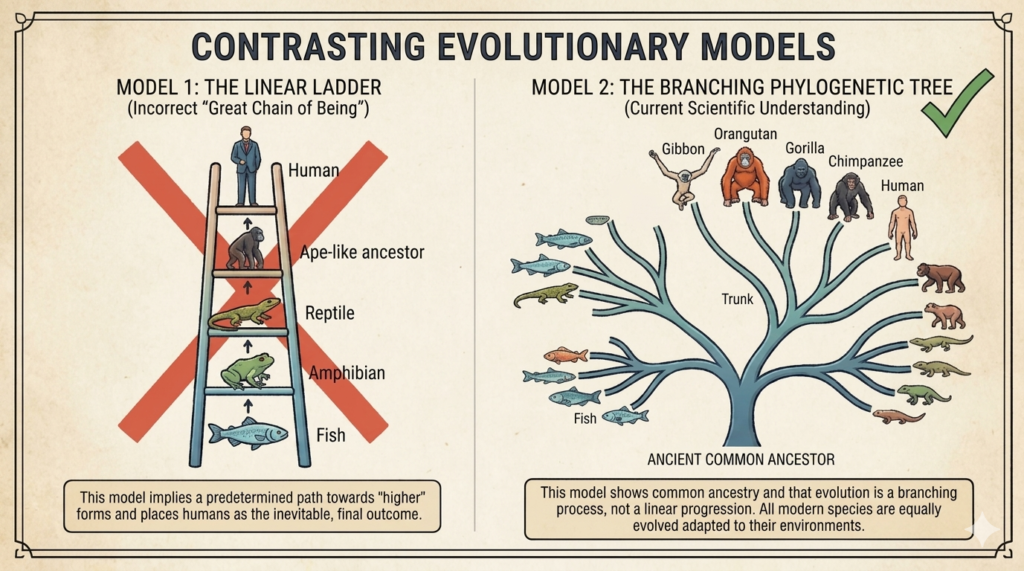
Humans did not evolve from the monkeys alive today.
Chimpanzees did not slowly transform into humans.
Instead, humans, chimpanzees, gorillas, and other living apes share common ancestors that lived millions of years ago. Those ancestral populations split into separate evolutionary lineages, each adapting to different ecological pressures over time.
Chimpanzees today are every bit as evolutionarily “modern” as humans.
Every living species occupies the tips of branches, not the bottom or the top.
Misconception 2: “Evolution Is Just a Theory”
This objection arises almost entirely from a misunderstanding of language.
In everyday conversation, the word theory often means a guess.
Someone might say,
“My theory is that it will rain tomorrow.”
Or,
“I have a theory about who stole my phone.”
Science uses the word very differently.
A scientific theory is not an unsupported speculation. It is a comprehensive explanatory framework that has survived repeated attempts at testing and falsification. It unites diverse observations into a coherent understanding of how part of the natural world works.
The theory of gravity explains why objects attract one another.
The germ theory of disease explains why microorganisms cause many illnesses.
The atomic theory explains the behavior of matter.
None of these are “just guesses.”
Evolution is both an observed fact and a scientific theory.
The fact is that populations change over generations. This has been directly observed in laboratories, hospitals, farms, and natural ecosystems.
The theory explains how and why those changes occur—through mechanisms such as mutation, natural selection, genetic drift, gene flow, and sexual selection.
Confusing these two meanings is like saying gravity is “just a theory” because scientists continue refining their understanding of how gravity works.
Scientific theories do not become facts.
Facts are observations.
Theories explain those observations.
Misconception 3: “Evolution Means Survival of the Strongest”
Few scientific phrases have been quoted more often—or misunderstood more completely.
“Survival of the fittest” was popularized by the philosopher Herbert Spencer after reading Darwin’s work. Although Darwin later used the phrase, it has encouraged generations of readers to imagine evolution as a brutal competition in which only the strongest survive.
But in evolutionary biology, fitness does not mean strength, intelligence, speed, or aggression.
It means reproductive success.
An organism is evolutionarily fit if it leaves more surviving offspring than competing individuals under a particular set of environmental conditions.
Evolution rewards whatever works—not whatever impresses us.
And what works today may fail tomorrow if the environment changes.
That is why evolution is not a march toward greatness.
It is an endless negotiation between organisms and the worlds they inhabit.
Understanding Evolution
What Evolution Actually Is
Imagine you are handed two photographs.
The first was taken of a small village in the year 1526.
The second was taken from exactly the same location 500 years later.
At first glance, they appear to show entirely different worlds.
The dirt paths have become paved roads. Wooden cottages have given way to brick houses and steel buildings. Horses have disappeared, replaced by cars and bikes. The population has grown, fashions have changed, languages have shifted, and technologies unimaginable to the villagers of 1526 now shape everyday life.
Yet none of these changes happened overnight.
No single morning arrived when every house transformed, every road appeared, and every resident suddenly adopted a new language.
Instead, thousands of tiny changes accumulated over centuries.
Each generation inherited a village that was almost identical to the one before it, yet slightly different. Most changes were so small that those living through them barely noticed. Only when separated by centuries does the transformation become obvious.
Biological evolution works in much the same way.
The difference is that instead of villages, it changes populations.
Instead of centuries, it often works across thousands or millions of generations.
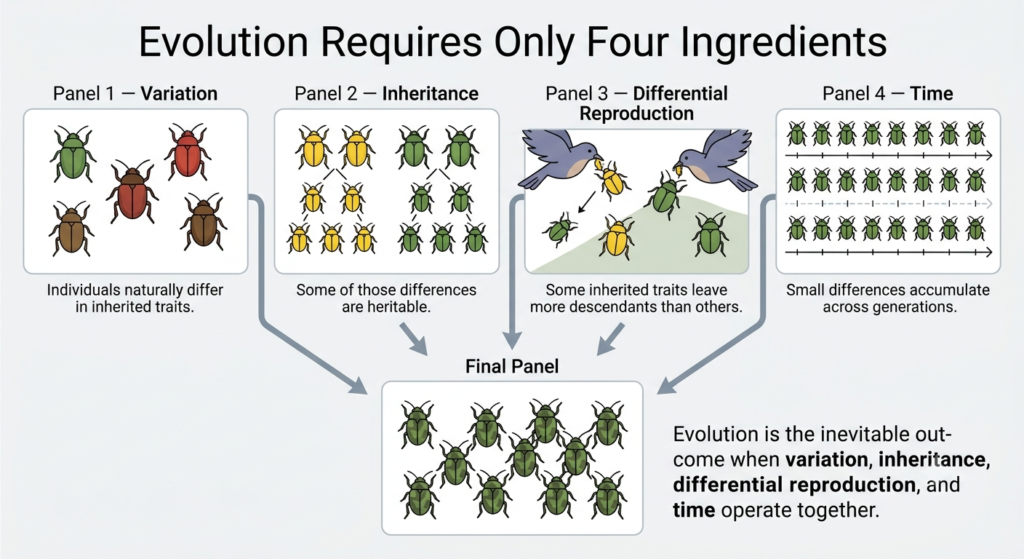
Evolution is not an event. It is the cumulative consequence of inheritance, variation, and differential reproduction acting over time.
The simplicity of this idea is almost unsettling.
Nature does not require a master blueprint explaining how every species should look.
It requires only organisms capable of making copies of themselves.
The rest follows inevitably.
Life Is a Copying Process
Every living organism is, in one sense, a copy.
You inherited your genetic instructions from your parents.
Your parents inherited theirs from your grandparents.
Those grandparents inherited theirs from earlier generations stretching backward through countless ancestors until the lineage disappears into the deep history of life itself.
Modern genetics has confirmed that every known organism uses DNA as its primary hereditary material (with a few viruses using RNA), employs nearly the same genetic code, and relies on remarkably similar molecular machinery to build proteins.
These similarities are not accidents. They are historical fingerprints.
Just as siblings resemble one another because they inherited genes from common parents, all life shares deep molecular similarities because every living organism ultimately descends from ancient common ancestors.
The history of life is therefore less like a collection of separate inventions and more like a single family-tree whose branches have diversified over billions of years.
But Copies Are Never Perfect
If you are copying a book by hand.
Most pages are reproduced accurately.
Occasionally, however, small mistakes appear.
After hundreds of generations of copying, the newest edition may differ substantially from the original despite no individual copy being dramatically different.
DNA behaves similarly.
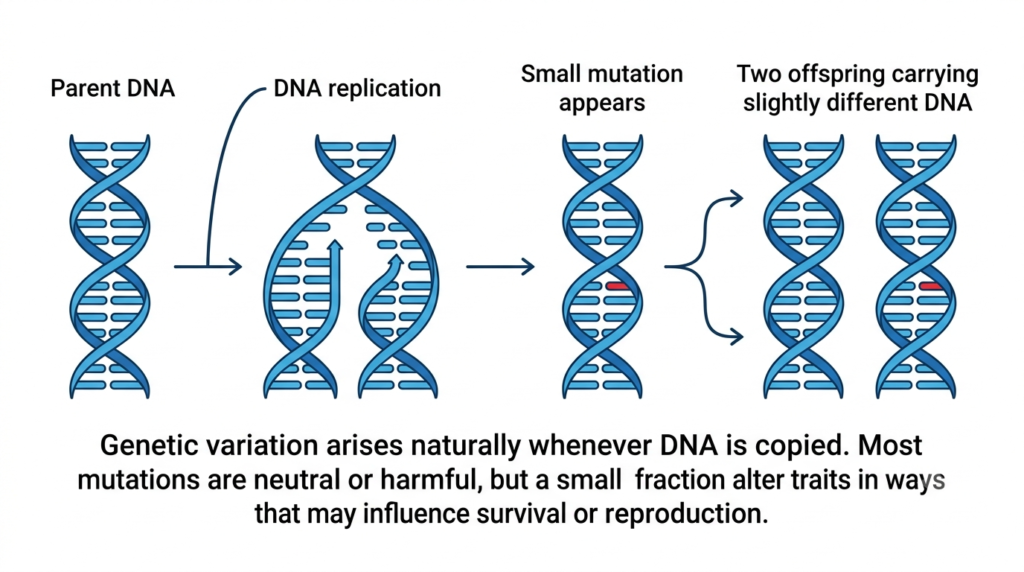
Although modern cells possess astonishingly accurate molecular proofreading systems, they are not perfect.
Every generation introduces new genetic variation.
These changes are called mutations.
Most changes have no effect.
Many are harmful.
A tiny fraction proves advantageous under particular environmental conditions.
Every adaptation that has ever evolved began as genetic variation appearing somewhere in an ancestral population.
Mutation does not tell evolution where to go. It simply creates possibilities.
Variation Is Everywhere
One of Darwin’s greatest insights came from something so ordinary that most people overlook it entirely.
No two individuals are exactly alike.
Every population contains diversity.
Evolution depends on that diversity.
Without variation, natural selection cannot favor one inherited trait over another because every individual would be biologically indistinguishable.
Variation is therefore not a flaw in life.
It is one of life’s greatest strengths.
It allows populations—not individuals—to respond to changing environments.
It simply preserves, generation after generation, those inherited variations that leave more descendants than competing alternatives.
The Invisible Filter Called Natural Selection
Imagine two oak trees standing side by side.
They produce thousands of acorns every autumn.
Some are eaten by birds.
Others are buried by squirrels and forgotten.
A few land in fertile soil.
Of the thousands of acorns produced, perhaps only one or two will eventually become mature trees capable of producing acorns of their own.
This is the essence of natural selection.
It is not a force in the way gravity is a force. It is the inevitable consequence of three simple facts:
- Organisms vary.
- Some of those variations are inherited.
- Individuals with variations tend to leave more or less offspring.
Nothing more mysterious is required.
Evolution Does Not Reward the Strongest
One of the most persistent myths about evolution is that it favors strength.
Nature, however, has no interest in strength, intelligence, beauty, complexity or morality.
The only biological “success” that matter is whether genes continue into future generations.
A lion that dominates every rival but dies before reproducing contributes nothing to future generations.
A small, unremarkable bird that successfully raises several chicks has been evolutionarily successful.
This is why evolutionary biologists define fitness very differently from everyday language.
Fitness does not mean “the best.”
It means the ability to survive long enough to leave fertile offspring under a particular set of environmental conditions.
There is no universally superior organism.
A polar bear is superbly adapted to Arctic Sea ice.
Move it into the Sahara Desert and its extraordinary adaptations become liabilities.
A dolphin is exquisitely adapted to the ocean yet would not survive a single day on land.
Evolution therefore produces organisms that are locally adapted, not universally perfect.
Why Evolution Has No Destination
Perhaps the greatest misunderstanding of all is the belief that evolution is climbing toward some final goal.
Look at almost any popular illustration of evolution and you will probably see it.
A bent ape slowly straightening into a modern human.
Life progresses upward.
Primitive becomes advanced.
Simple becomes complex.
Monkey becomes man.
It is one of the most famous images in science.
It is also one of the most misleading.
Every species alive today has been evolving for exactly the same amount of time since life first appeared on Earth.
Bacteria are not “primitive.”
They are extraordinarily successful organisms that have had nearly four billion years to evolve.
In fact, bacteria remain the most abundant and diverse forms of life on the planet.
From an evolutionary perspective, humans are not “higher” than bacteria.
We are simply different.
The idea of progress largely comes from our tendency to judge evolution using human values.
We admire intelligence, technology and large brains.
So, we imagine evolution was somehow aiming toward creatures like ourselves.
Nature has no such ambitions.
There is no evidence that humans—or any particular species—were inevitable.
The first three ingredients of evolution—variation, inheritance, and differential reproduction—operate every generation.
The fourth ingredient is what transforms tiny changes into extraordinary biological diversity.
Time.
Human intuition struggles with deep time.
We easily understand ten years.
Perhaps even a hundred.
A thousand years begins to feel abstract.
A million years is almost impossible to visualize.
A billion years lies completely outside ordinary experience.
Yet evolution operates across precisely these immense timescales.
Consider a single millimeter.
Now imagine adding another millimeter every year.
After one year, the change is invisible.
After ten years, still insignificant.
After one hundred years, only ten centimeters.
But continue for one million years, and the accumulated distance becomes one thousand kilometers.
Tiny increments become enormous through persistence.
Evolution works in much the same way.
Individual generations differ only slightly from those that came before.
Parents resemble their children.
Children resemble their parents.
Nothing dramatic happens in a single lifetime.
But across tens of thousands—or millions—of generations, those small inherited differences accumulate into transformations so profound that descendants may no longer resemble their distant ancestors at all.
This is why fossils appear to show dramatic jumps while everyday life appears stable.
We observe snapshots separated by vast intervals.
Evolution fills the spaces between them.
Evolution Is a Population Process
One of the hardest ideas for newcomers is that individual organisms do not evolve.
You will not evolve during your lifetime.
A giraffe does not stretch its neck and pass that acquired length to its offspring.
A weightlifter’s children are not born muscular because their parents exercised.
Individuals develop, grow and learn.
But populations evolve.
Suppose a population of wild rabbits contains natural variation in fur thickness.
Then imagine the climate gradually becomes colder.
Rabbits with slightly thicker fur survive winter a little more often and produce slightly more offspring.
Those offspring inherit genes contributing to thicker fur.
Generation after generation, the proportion of thick-furred rabbits increases.
Notice what did not happen.
No rabbit consciously decided to grow thicker fur.
The environment did not create thicker fur because the rabbits needed it.
Instead, the population already contained variation.
Natural selection altered the frequency of that variation through differential reproductive success.
That is evolution.
The Modern Definition of Evolution
After everything we have discussed, we can finally return to the definition often found in biology textbooks.
Evolution is commonly defined as:
A change in the genetic composition of a population across successive generations.
Every word matters.
Population, because evolution acts on groups rather than individuals.
Genetic composition, because inherited DNA carries biological information.
Change, because populations are never perfectly static.
Successive generations, because evolution unfolds through reproduction over time.
Behind that concise definition lies the entire history of life on Earth.
The Evidence
Science Doesn’t Prove Ideas—It Tries to Break Them
One of the most common misconceptions about science is that scientists set out to prove themselves right.
The reality is almost the opposite.
Science progresses by attempting to prove ideas wrong.
Every serious scientific hypothesis lives under constant attack.
Researchers look for contradictions.
Theories survive not because scientists protect them, but because repeated attempts to overturn them fail.
Evolution has endured this process for more than 165 years.
It has been tested by disciplines that Darwin never imagined.
When Charles Darwin published On the Origin of Species in 1859, scientists knew nothing about DNA, genes, radioactivity or developmental biology.
If Darwin’s central idea had been fundamentally wrong, each of these discoveries offered an opportunity for it to collapse.
Instead, every major breakthrough strengthened it.
This is one of the strongest reasons scientists regard evolution as one of the most robust theories in modern science.
What Would We Expect If Evolution Were False?
This question is rarely asked.
Consider, for a moment, that species were entirely unrelated.
That every organism had appeared independently without any common ancestry.
What kind of world should we expect?
Probably something like this.
Genes would be completely different between unrelated organisms.
There would be no consistent pattern connecting humans with chimpanzees, mice, whales, or bacteria.
Embryos would develop according to entirely different blueprints.
Fossils would appear randomly throughout geological layers.
Ancient rabbits might be found alongside dinosaurs.
Human skeletons could appear in rocks hundreds of millions of years old.
Bird wings could be built from completely different bones than human arms.
Instead, the world looks astonishingly different.
Every line of evidence points toward shared ancestry.
Independent fields of science, often developed for entirely different purposes, converge upon the same conclusion.
This convergence is one of the hallmarks of reliable scientific knowledge.
When geology, genetics, embryology, anatomy, ecology, and molecular biology all arrive independently at the same answer, confidence increases dramatically.
The strength of evolution lies not in any single piece of evidence.
It lies in the remarkable agreement between many completely independent kinds of evidence.
Evidence Is Not Democracy
Some people imagine that scientific theories become accepted because many scientists vote in their favor.
Science does not work by popularity.
A single well-documented observation can overturn decades of accepted thinking.
History contains many examples.
The discovery that continents move transformed geology.
The realization that stomach ulcers are often caused by bacteria revolutionized medicine.
The idea of expansion of the universe reshaped cosmology.
Scientists changed their minds because evidence demanded it.
The same standard applies to evolution.
If a human fossil were reliably discovered inside rocks dating from the age of dinosaurs, evolutionary biology would face an enormous crisis.
If mammals consistently appeared before fish in the fossil record, evolutionary theory would require major revision.
Scientists have spent more than a century looking for precisely these kinds of contradictions, instead, every major discovery has strengthened the pattern Darwin first recognized.
Scientists are not committed to evolution because it is philosophically satisfying.
They are committed to it because alternative explanations repeatedly fail to explain the evidence with equal power.
The Fossil Record: Nature’s History Book
Of all the evidence supporting evolution, fossils are perhaps the most familiar.
Many people imagine the fossil record as a complete archive of every organism that has ever lived.
It is nothing of the sort.
Fossilization is extraordinarily rare.
When an animal dies, its body is usually destroyed.
Scavengers consume it.
Bacteria decompose it.
Most organisms leave no trace at all.
To become a fossil, a remarkable chain of unlikely events must occur.
The organism must be buried rapidly.
It must avoid scavengers.
Chemical conditions must preserve rather than destroy its remains.
The surrounding sediments must eventually harden into rock.
Millions of years later, erosion—or a fortunate paleontologist—must expose it again.
This means the fossil record is incomplete.
And yet, despite those enormous gaps, it displays one of the clearest patterns in all of science.
The deeper we dig into Earth’s rocks, the simpler life becomes.
Single-celled organisms appear before multicellular organisms.
Fish appear before amphibians.
Amphibians before reptiles.
Reptiles before mammals.
Land mammals before whales.
Early members of our own lineage long before modern humans.
Never the reverse.
It is exactly what evolution predicts.
If species descend from earlier species through gradual modification, the history of life should unfold in a branching sequence through geological time.
That is precisely what the rocks reveal.
The rocks preserve history.
And history has a direction.
DNA: The History Book Written Inside Every Cell
For more than a century, fossils were the strongest evidence for evolution. Then, in the second half of the twentieth century, scientists discovered something even more powerful—not buried in ancient rocks, but hidden inside every living cell.
Imagine trying to reconstruct your family history.
You could search old photographs, read birth certificates or interview elderly relatives.
Perhaps you would discover letters written by great-grandparents.
Each source would reveal part of the story.
Now imagine every member of your family carried, within their own body, a document describing their ancestry accurately enough that distant cousins could be identified even if all historical records had disappeared.
That is essentially what DNA provides.
It is history written in chemistry.
Similarity Is More Than Coincidence
Many people know that humans share approximately 98–99% of their DNA with chimpanzees, depending on how the comparison is performed.
This statistic often surprises people.
It shouldn’t.
If humans and chimpanzees share a relatively recent common ancestor, high genetic similarity is exactly what evolution predicts.
More importantly, similarity follows a consistent pattern.
Humans resemble chimpanzees more than gorillas.
Humans resemble gorillas more than monkeys.
Humans resemble monkeys more than mice and so on.
This genetic hierarchy matches precisely the relationships inferred independently from fossils, anatomy, embryology, and comparative physiology.
These disciplines developed largely independently.
Yet they converge upon the same branching evolutionary tree.
That agreement would be extraordinarily unlikely if species had no historical relationships.
The Genome Is Not Just Information
Your genome is not merely a blueprint for building your body.
It is also a historical document.
Every chromosome contains traces of ancient ancestry.
Every gene carries evidence of countless generations of inheritance.
Every mutation marks another step in a journey stretching back nearly four billion years.
When biologists sequence a genome, they are not simply reading biological instructions.
They are reading history as well.
And history, written independently inside billions of cells across millions of species, tells the same story as fossils buried in ancient rocks that all life is related by inheritance.
Pseudogenes: The Ghosts of Functional Genes
Your genome contains approximately twenty thousand protein-coding genes.
These genes perform essential tasks—building proteins, regulating development, repairing DNA, and controlling countless biological processes.
But scattered among them are thousands of genetic relics.
These are known as pseudogenes.
A pseudogene is essentially a gene that once functioned but no longer does.
Over evolutionary time it accumulated mutations that disrupted its original role.
It is rather like an abandoned factory.
At first, pseudogenes puzzled scientists.
Why would organisms carry apparently broken genes?
Wouldn’t natural selection eliminate useless DNA?
The answer is subtle.
Natural selection is extremely effective at removing mutations that reduce reproductive success.
It is much less effective against changes that are essentially neutral.
Once a gene loses its function, additional mutations often have little effect on survival.
Over millions of years, these genetic fossils gradually accumulate.
The most intriguing discovery came when researchers compared pseudogenes across different species.
Closely related organisms often possess the same pseudogene, disrupted by the same disabling mutation, in exactly the same chromosomal location.
This pattern strongly suggests inheritance from a shared ancestor rather than independent origin.
The Vitamin C Gene We No Longer Use
One of the best-known examples involves vitamin C.
Most mammals manufacture vitamin C inside their own bodies using a functional gene known as GULO.
Humans cannot.
Nor several other primates.
As a result, we must obtain vitamin C through our diet.
Without sufficient intake, the collagen in our connective tissues begins to fail, leading to the disease scurvy—a condition that devastated sailors during long ocean voyages before the nutritional cause was understood.
Why are humans unable to synthesize a vitamin that most mammals produce with ease?
Comparative genomics provides a fascinating answer.
The human GULO gene still exists.
So do the corresponding genes in other great apes.
But in each species, the gene has been disabled by mutations.
It no longer produces a functional enzyme.
Rather than being absent, it survives as a pseudogene—a molecular relic of an ancestor that once possessed a working vitamin C pathway.
The fact that closely related primates share the same disabled system in corresponding genomic locations is far more informative.
It is exactly the kind of pattern expected if these species inherited the mutation from a common ancestor.
Endogenous Retroviruses: Ancient Viral Fossils
Viruses are often thought of as temporary invaders.
The immune system eventually clears the infection.
Occasionally, however, something extraordinary happens.
Certain viruses—known as retroviruses—insert their genetic material directly into the DNA of the cells they infect.
If that infection occurs in ordinary body cells, the viral DNA dies with the individual.
But if a retrovirus infects a sperm or egg cell, the viral sequence can become part of the genome passed to future generations.
From that moment onward, descendants inherit the viral DNA exactly as they inherit ordinary genes.
These inherited viral fragments are called endogenous retroviruses, or ERVs.
Today, roughly eight percent of the human genome consists of ancient retroviral sequences accumulated over millions of years.
Most are inactive.
A few have even been repurposed by evolution.
One remarkable example is syncytin, a protein derived from an ancient viral gene that now plays an essential role in forming the human placenta.
Evolution, characteristically, has recycled yesterday’s parasite into today’s indispensable biology.
The real evolutionary significance of ERVs, however, lies elsewhere.
Closely related species often possess identical viral insertions at precisely the same positions within their genomes.
The probability that unrelated retroviruses independently inserted themselves into the same chromosomal location across multiple species again and again is extraordinarily low.
Inheritance from a common ancestor provides a far simpler explanation.
Hox Genes: One Toolbox, Endless Forms
Perhaps the most beautiful genetic evidence for evolution comes not from broken genes but from genes that still work.
Among the most famous are the Hox genes.
These genes help establish the body plan of an embryo.
They determine where the head forms, where the thorax develops, and where limbs emerge.
What astonished developmental biologists was that different animals possess remarkably similar Hox genes inherited from ancient ancestors.
The same genetic toolkit has been modified, duplicated, regulated, and redeployed across hundreds of millions of years.
Evolution doesn’t often invent rather it rearranges existing components in new ways.
This insight gave rise to the field of evolutionary developmental biology, or Evo-Devo, revealing that dramatic differences between organisms often arise not from entirely new genes but from changes in when, where, and how strongly ancient genes are expressed.
The diversity of life is therefore not evidence against common ancestry.
It is evidence of what a shared genetic toolkit can achieve over immense spans of evolutionary time.
Evolution in Real Time
Watching Evolution Happen
Some of us might think that evolution is too slow to observe.
After all, if the transformation of fish into amphibians required millions of years, how could any human hope to witness evolution within a single lifetime?
The answer lies in understanding what evolution actually measures.
Evolution is not defined by the appearance of entirely new kinds of organisms overnight. It is defined by changes in the genetic composition of populations across generations. Those changes can occur over millions of years—but they can also occur in months, weeks, or even days when organisms reproduce rapidly and face strong selective pressures.
For bacteria dividing every twenty minutes, thousands of generations can pass in the time it takes a human child to finish primary school. Viruses, with their extraordinary mutation rates and enormous population sizes, evolve even more quickly. Evolution, therefore, is not always a slow process. Its pace depends on generation time, mutation rate, population size, and the intensity of natural selection.
This is why modern biology no longer relies solely on fossils to study evolution.
Today, scientists can observe evolutionary change as it unfolds.
Perhaps the clearest example comes from one of medicine’s greatest challenges: antibiotic resistance.
When antibiotics were first introduced in the twentieth century, they transformed medicine. Many believed infectious bacterial diseases would soon become relics of history.
Nature had other plans.
Within any large bacterial population, genetic variation already exists. Occasionally, a mutation arises that makes one bacterium slightly less vulnerable to a particular antibiotic. When the drug is administered, most bacteria die. The rare resistant individuals survive, reproduce, and pass their resistance genes to future generations. After repeated exposure, the once-rare resistant bacteria can become the dominant strain.
The antibiotic did not cause bacteria to “decide” to become resistant.
Nor did it create beneficial mutations because the bacteria needed them.
The mutations arose naturally before exposure. The antibiotic simply changed which bacteria survived long enough to reproduce.
This is natural selection occurring before our eyes.
Hospitals around the world witness this process continuously. The emergence of drug-resistant strains of Staphylococcus aureus, Mycobacterium tuberculosis, and other pathogens is not a theoretical possibility—it is an ongoing evolutionary process with profound consequences for global health.
Evolution in a Bottle: The Long-Term Evolution Experiment
In February 1988, evolutionary biologist Richard Lenski began what appeared to be a remarkably simple experiment.
He placed twelve identical populations of the common bacterium Escherichia coli into separate flasks containing a carefully controlled growth medium.
Every day, each population was transferred into fresh medium.
The bacteria grew.
Divided.
Mutated.
Competed.
Then the cycle began again.
The routine was almost monotonous.
Transfer.
Grow.
Freeze samples.
Repeat.
Days became months.
Months became years.
Years became decades.
Few scientific experiments have continued with such consistency for so long.
Today, the Long-Term Evolution Experiment (LTEE) has followed these bacterial populations through more than 75,000 generations, making it one of the longest-running evolution experiments in history.
Why is this experiment so important?
Because every variable except evolution itself was carefully controlled.
The bacteria experienced the same temperature.
The same nutrients.
The same laboratory conditions.
The same daily routine.
Yet over time, the populations began to diverge.
Mutations accumulated independently in each lineage.
Some populations evolved faster growth.
Others became better at competing for limited resources.
Although they all began from the same ancestral strain, they gradually followed different evolutionary paths.
This is precisely what evolutionary theory predicts.
Random mutations continually generate variation.
Natural selection favors variants that reproduce more efficiently under existing environmental conditions.
Over thousands of generations, even tiny differences accumulate into measurable evolutionary change.
One of the greatest strengths of the LTEE is that scientists did not simply observe change—they preserved its history.
Every few hundred generations, samples from each bacterial population were frozen at ultra-low temperatures.
These frozen bacteria remain alive but metabolically inactive.
Researchers can thaw samples collected decades apart and allow ancient and modern bacteria to compete directly against one another.
Again and again, modern descendants outperform their ancestors in the environment in which they evolved.
Evolution is not inferred.
It is measured.
When Evolution Produced Something New
The most celebrated discovery from the LTEE occurred after roughly 31,000 generations.
Under the experimental conditions, E. coli normally feeds on glucose.
The growth medium also contained citrate, but oxygen-rich conditions prevent ordinary E. coli from using citrate as a food source.
For microbiologists, this limitation was so reliable that the inability to consume citrate in the presence of oxygen had long been considered one of the defining characteristics of the species.
Then something unexpected happened.
One bacterial population began growing on citrate.
At first, the result seemed almost unbelievable.
Could contamination have occurred?
Were different bacteria somehow introduced into the flask?
Extensive testing ruled out those possibilities.
Instead, researchers discovered that a series of earlier mutations had prepared the population for a rare genetic rearrangement that activated an existing citrate transporter under aerobic conditions.
The bacteria had evolved a new metabolic capability.
No entirely new gene appeared from nowhere.
Rather, existing genetic components were modified, regulated differently, and combined through ordinary evolutionary processes.
This illustrates an important principle often overlooked in discussions of evolution.
Evolution frequently innovates not by inventing entirely new biological machinery from scratch, but by repurposing, duplicating, and rewiring components that already exist.
The citrate-evolving bacteria became one of the clearest experimental demonstrations that evolutionary novelty can emerge through cumulative genetic change.
Evolution is therefore best understood not as a march toward perfection but as an ongoing conversation between organisms and their environments—a conversation that has continued for nearly four billion years and shows no sign of ending.
References
Alberts, B., Johnson, A., Lewis, J., Morgan, D., Raff, M., Roberts, K., & Walter, P. (2022). Molecular Biology of the Cell (7th ed.). Garland Science.
Carroll, S. B. (2005). Endless Forms Most Beautiful: The New Science of Evo Devo. W. W. Norton & Company.
Carroll, S. B. (2008). Evo-devo and an expanding evolutionary synthesis: A genetic theory of morphological evolution. Cell, 134(1), 25–36. https://doi.org/10.1016/j.cell.2008.06.030
Coyne, J. A. (2009). Why Evolution Is True. Viking.
Darwin, C. (1859). On the Origin of Species. John Murray.
Dobzhansky, T. (1973). Nothing in biology makes sense except in the light of evolution. The American Biology Teacher, 35(3), 125–129.
Futuyma, D. J., & Kirkpatrick, M. (2017). Evolution (4th ed.). Sinauer Associates.
Jacob, F. (1977). Evolution and tinkering. Science, 196(4295), 1161–1166.
Kimura, M. (1983). The Neutral Theory of Molecular Evolution. Cambridge University Press.
Lenski, R. E., Rose, M. R., Simpson, S. C., & Tadler, S. C. (1991). Long-term experimental evolution in Escherichia coli. I. Adaptation and divergence during 2,000 generations. The American Naturalist, 138(6), 1315–1341.
Lenski, R. E. (2017). Experimental evolution and the dynamics of adaptation and genome evolution in microbial populations. The ISME Journal, 11, 2181–2194.
Blount, Z. D., Borland, C. Z., & Lenski, R. E. (2008). Historical contingency and the evolution of a key innovation in an experimental population of Escherichia coli. Proceedings of the National Academy of Sciences, 105(23), 7899–7906.
Mayr, E. (2001). What Evolution Is. Basic Books.
Nowell, P. C. (1976). The clonal evolution of tumor cell populations. Science, 194(4260), 23–28.
Ohno, S. (1970). Evolution by Gene Duplication. Springer.
Shubin, N. (2008). Your Inner Fish. Pantheon Books.
Shubin, N., Tabin, C., & Carroll, S. B. (2009). Deep homology and the origins of evolutionary novelty. Nature, 457, 818–823.
Stearns, S. C., & Hoekstra, R. F. (2005). Evolution: An Introduction (2nd ed.). Oxford University Press.
Theobald, D. L. (2010). A formal test of the theory of universal common ancestry. Nature, 465, 219–222.
The Chimpanzee Sequencing and Analysis Consortium. (2005). Initial sequence of the chimpanzee genome and comparison with the human genome. Nature, 437, 69–87.
Urry, L. A., Cain, M. L., Wasserman, S. A., Minorsky, P. V., Orr, R. B., & Reece, J. B. (2020). Campbell Biology (12th ed.). Pearson.
Varki, A., & Altheide, T. K. (2005). Comparing the human and chimpanzee genomes. Genome Research, 15(12), 1746–1758.
Wiser, M. J., Ribeck, N., & Lenski, R. E. (2013). Long-term dynamics of adaptation in asexual populations. Science, 342(6164), 1364–1367.